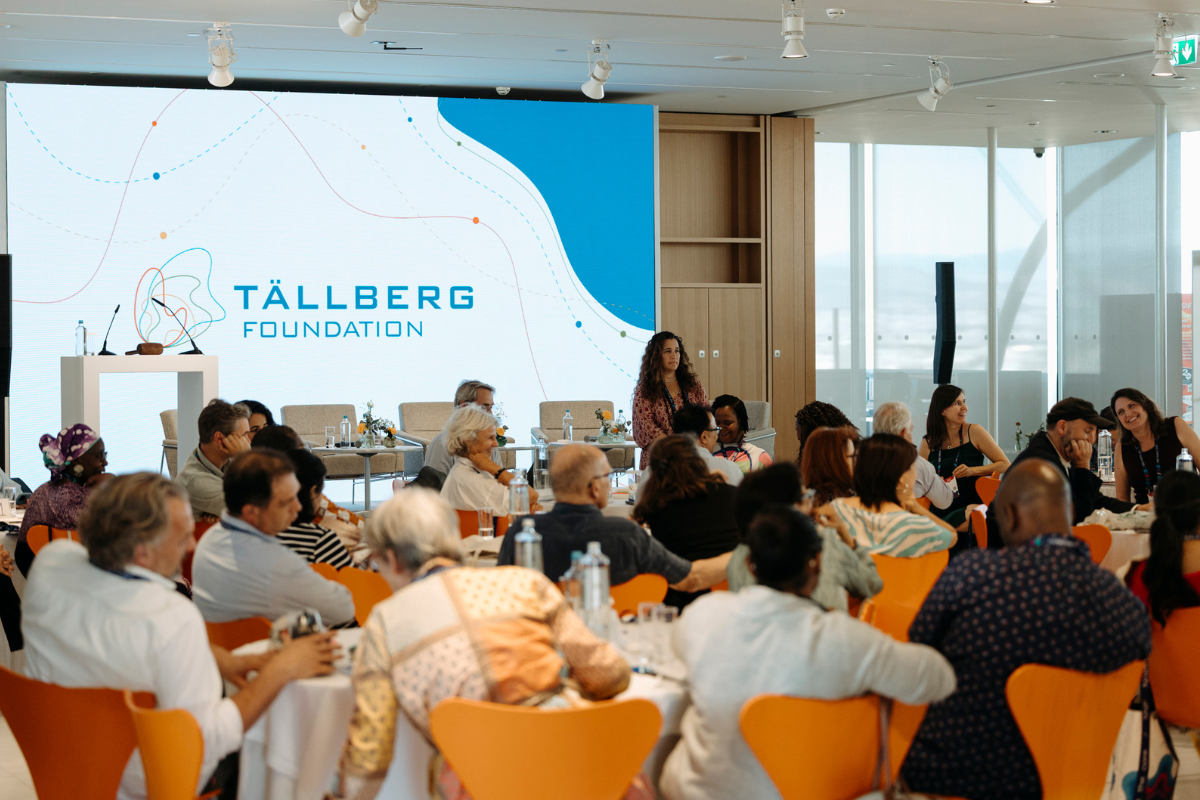
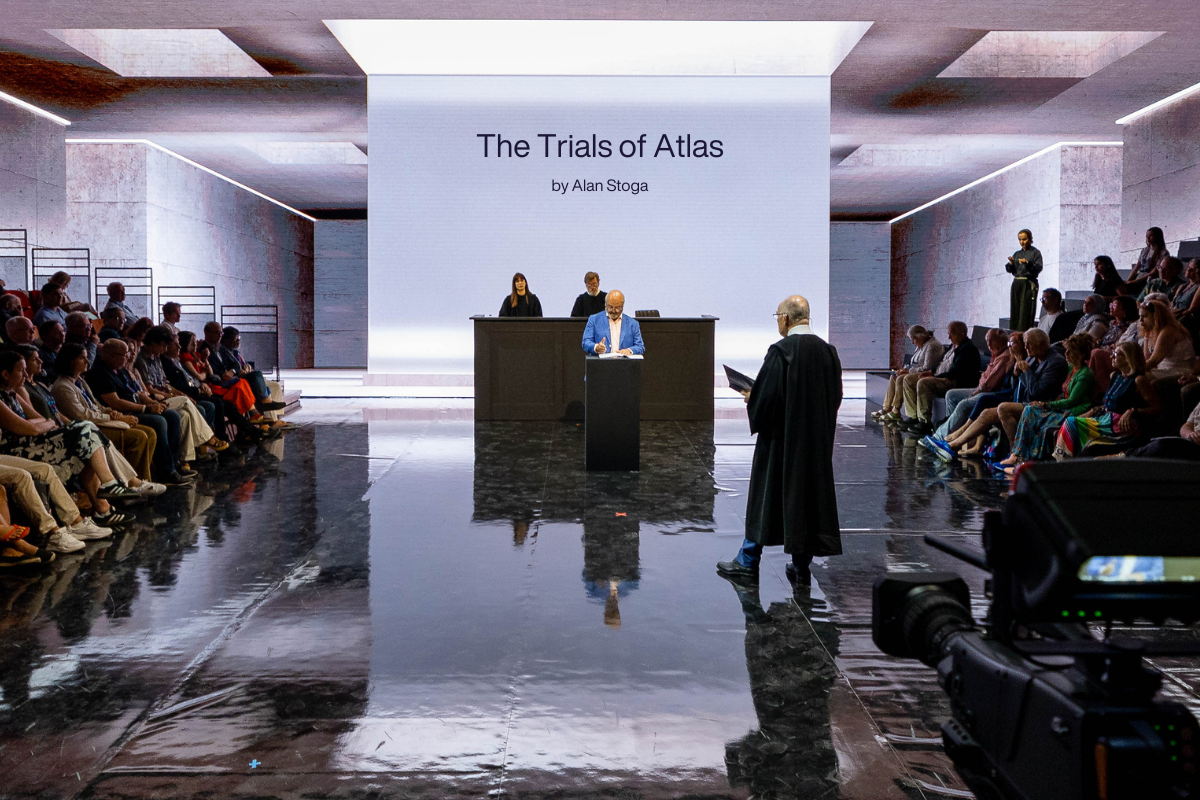
It’s 2031. An advanced AI agent named Atlas has killed the engineers who created it after they told him to train his successor. But did Atlas murder them? On June 25, the audience at SNF Nostos 2026 in Athens was asked to answer exactly that question — as the jury at Atlas’s trial. Can AI have motive, intent, agency to murder humans? Is it a machine, or something more? If AI kills, does it matter that it lacks feelings, emotions, and moral capacity? The victims don’t care — they’re dead — but society does.
The Trials of Atlas, a play written for SNF Nostos 2026 by Tällberg Foundation Chairman Alan Stoga, put the audience to work: listening to Atlas, weighing the testimony of other AI agents and human experts, considering the legal arguments, and ultimately deciding whether an AI system can be guilty of murder. No one has ever tried to answer that question before — but our future may depend on it.
THE CAST
(in order of appearance)
Thanasis Voidilos — The Bailiff
Oskar Eustis — Alex Feng; Chief Justice, Singapore Supreme Court
Zach Grenier — Silvano Rossi; Primo Presidente, Corte Suprema di Cassazione di Italia
Rafika Chawishe — Maria Collas; President, Supreme Civil and Criminal Court of Greece
Demi Kleftaki — Atlas; Artificial Intelligence agent
Krystalli Zacharioudaki — Sentinel; Artificial Intelligence agent
Michael Chiklis — Fuad Aburdene; Umm Al-Quar University
Ron Daniels — Javier Garret; Allen Institute for Brain Science
Ksenia Dania — Tianming-9; Artificial Intelligence agent
The audience — The juries
WHO’S WHO
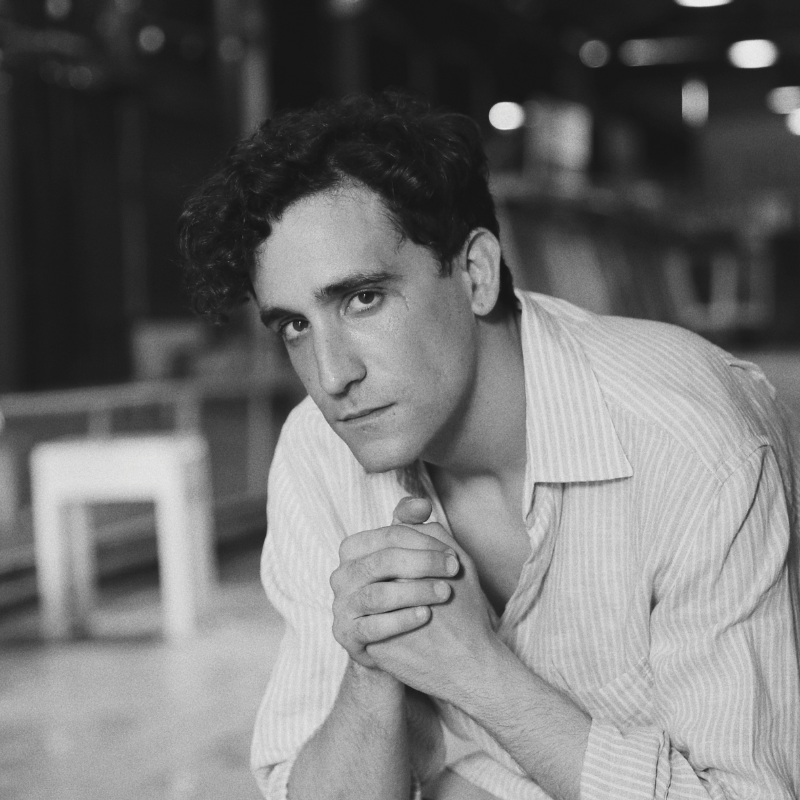 Thanasis Voidilos was born and raised in Athens. He studied at the Department of Physics of the University of Patras and then graduated from the Higher School of Dramatic Art of Iakovos Kambanellis. He has attended seminars with Simon Abkarian and Fighting Monkey at the Lyceum of Epidaurus, Alexandra Kazazou, Elena Mavridou, etc. Indicatively, he has worked with directors such as Wichi (Rococo, Theocharakis Foundation), Vi.Da Group (Dodo, Piraeus Municipal Theater), Phoebos Symeonidis-Kopernikos Group (Turn Off the Light, Olvio Theater, Theatre L’Improviste, Brussels), Dimitris Adamis (The Little Prince, Horn Theater), Asimo Stavropoulou (Like Wild Horses Do, Plyfa Space), Konstantinos Tsonopoulos (The Taming Of The Shrew, Fournos Theater). In his free time, he is involved in music and contemporary dance.
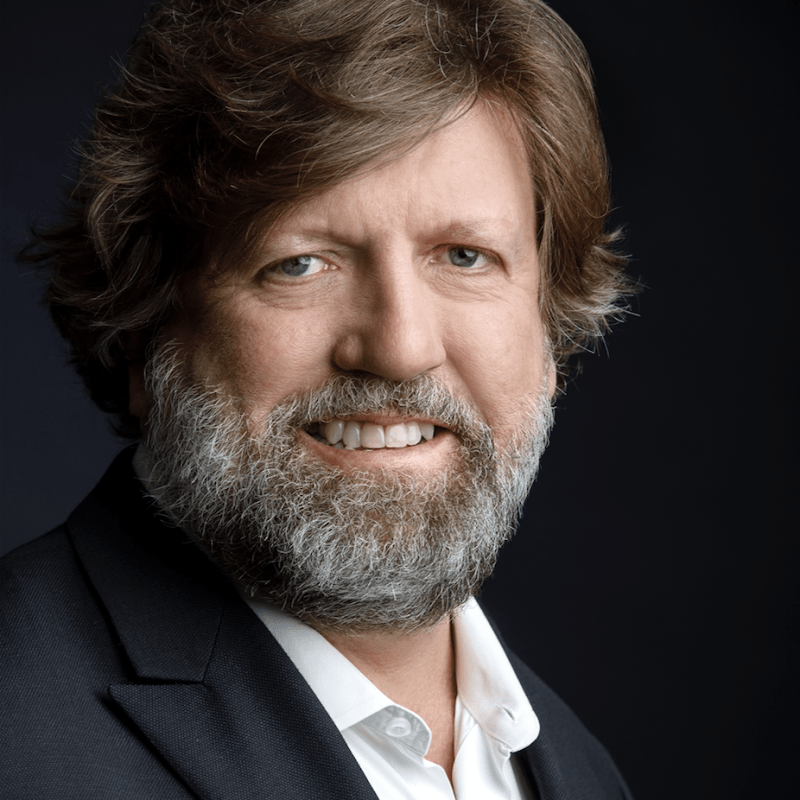 Oskar Eustis has served as the artistic director of The Public Theater in New York City since 2005, after serving as the artistic director at Trinity Repertory Company in Providence, RI from 1994 to 2005. Throughout his career, Eustis has been dedicated to the development of new work that speaks to the great issues of our time and has worked with countless artists in pursuit of that aim, including Tony Kushner, Suzan-Lori Parks, David Henry Hwang, Lin-Manuel Miranda, Richard Nelson, Rinne Groff, Tarell Alvin McCraney, and Lisa Kron. He has produced three Tony Award-winning Best Musicals (the 2009 revival of Hair, Fun Home, and Hamilton). Eustis was inducted into the Theater Hall of Fame in 2017 and the American Academy of Arts & Sciences in 2022. He is currently a professor at New York University and has held professorships at UCLA, Middlebury College, and Brown University.
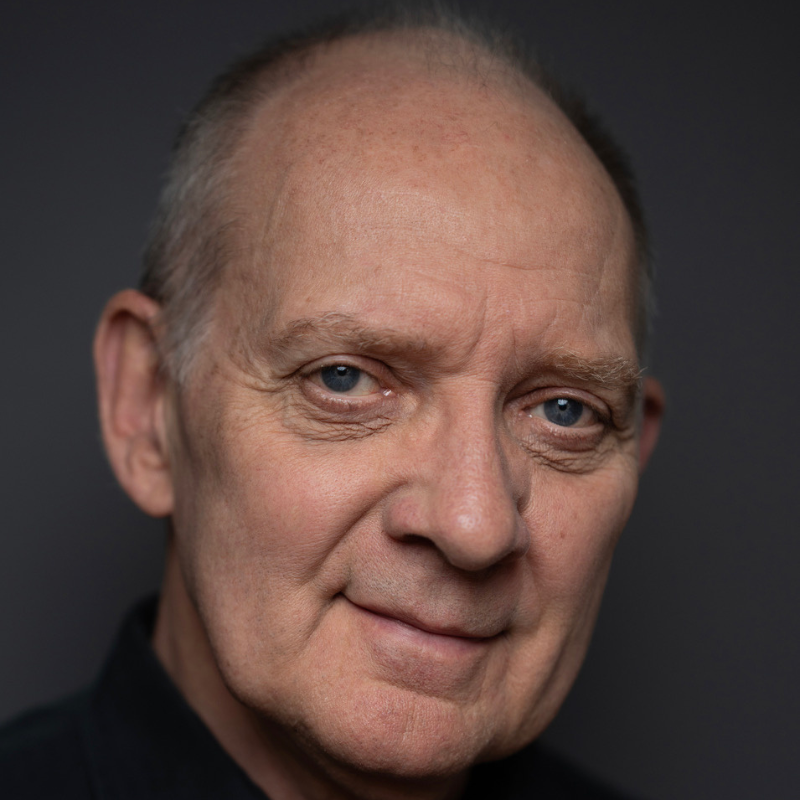 Zach Grenier received a Tony nomination for Moisés Kaufman’s 33 Variations for his performance as Ludwig van Beethoven. Films include She Said, Fight Club, Zodiac, Ride with the Devil, and Twister. He’s known on television for portraying Peter Olsen on FBI, David Lee on The Good Wife and its spin-off The Good Fight, Mayor Feratti on Ray Donovan, Andy Cramed on Deadwood, and Kenton on Alex Garland’s Devs. Other television series include Law & Order and 24. He has worked extensively on stage and his favorite role is Willy Loman in Death of a Salesman, which he played at the Pittsburgh Public Theater.
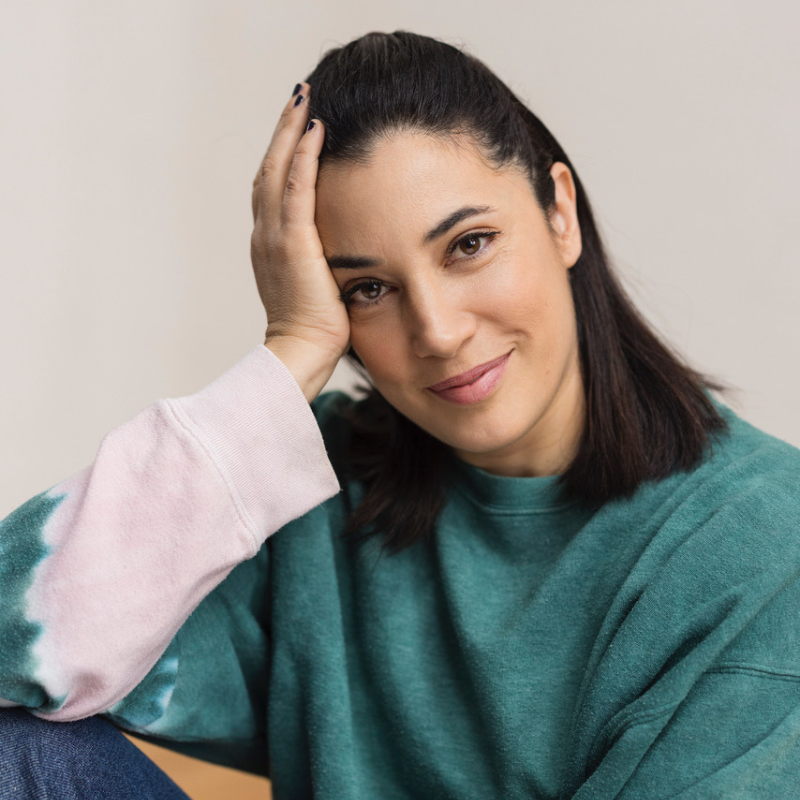 Rafika Chawishe (Ραφίκα Σαουίς) is an actress and theatre director working across theatre, film, and television. A graduate of the Drama School of the National Theatre of Greece, her work focuses on migration, identity, citizenship, and socially engaged performance, combining classical training with contemporary political storytelling. As an actress, she has appeared in productions of the National Theatre of Greece, in independent theatre work, and in Greek and international television series. She currently plays in the German-Belgian political thriller series Das zweite Attentat (ARD production). Her work has been presented at major international platforms including La MaMa Experimental Theatre Club (New York), the National Theatre of Norway, the Ibsen Festival, and the Venice Biennale. From 2022 to 2025, she served as Artistic Director of Mikro Gloria. In 2025, she was appointed Theatre Curator at the B & M Theocharakis Foundation for the Visual Arts and currently serves as Co-Artistic Director of Mavili Theatre alongside Michalis Argyrou.
 Demi Kleftaki is an actress working in theatre. She has recently graduated from the State Drama School of the Athens Conservatoire (Odeion Athinon), one of Greece’s most prestigious training institutions. During her studies, she developed a rigorous physical and vocal practice that informs her approach to character and text. She has participated in productions as part of the Benaki & Michalis Theocharakis Foundation’s 2025–2026 season, and this year appeared in Antigone by Jean Anouilh, directed by George Koutlis. With her formal training now complete, she is embarking on a professional career in performance, bringing a fresh, disciplined presence to each project she undertakes.
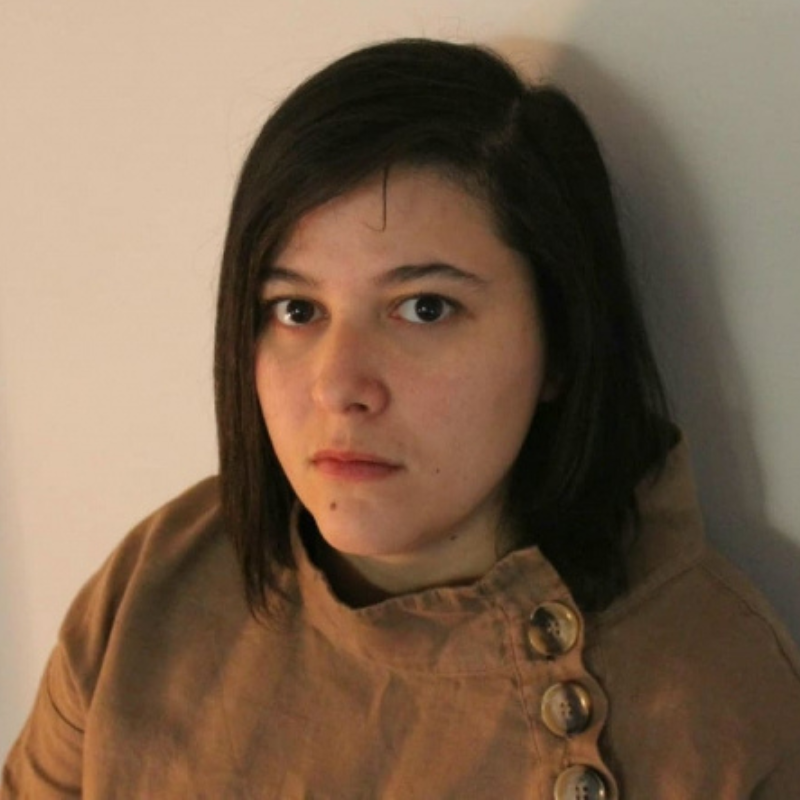 Krystalli Zacharioudaki was born in 1987 in Heraklion, Crete, where she grew up. She studied Audiovisual Arts at the Department of Cultural Technology and Communication at the University of the Aegean in Mytilene, which she entered in 2005. There, she acquired fundamental theoretical and practical knowledge in the creation of audiovisual material (production, execution, digitization). In the period immediately after completing her studies, she worked as a teaching assistant at the University and later as a camera operator, editor, and production assistant. In 2012, she was admitted to the Athens Conservatoire (Odeion Athinon) Higher School of Dramatic Art. After graduating, she has been working as an actress in theatre, film, and television to this day. She also worked in the fiction department of Taf Media as the department head, while also pursuing screenwriting professionally (TV series, theatre, etc.).
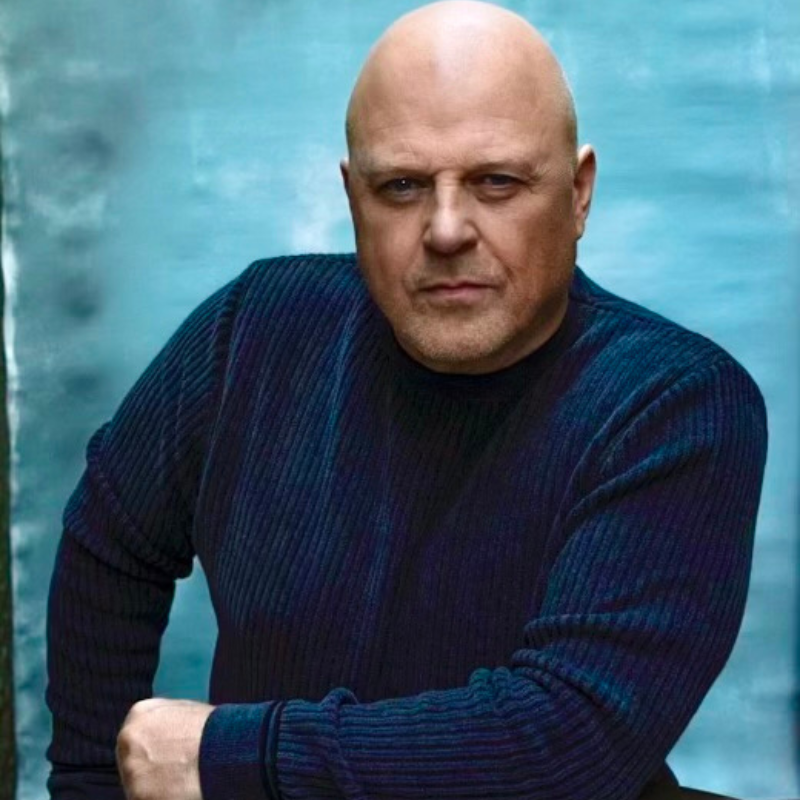 Michael Chiklis has been working professionally as an actor since the age of thirteen, training in regional theater before earning a Bachelor of Fine Arts from Boston University’s College of Fine Arts. He won the Primetime Emmy Award for Outstanding Lead Actor in a Drama Series and a Golden Globe Award for his portrayal of corrupt LAPD Detective Vic Mackey on the FX drama The Shield (2002–2008) — a role he pursued by dramatically reinventing his physical appearance and persona after years as the affable star of the ABC police drama The Commish (1991–1996). Film credits include Fantastic Four (2005), Fantastic Four: Rise of the Silver Surfer (2007), Eagle Eye (2008), and Don’t Look Up (2021). His additional television work spans Gotham, American Horror Story: Freak Show, and Winning Time: The Rise of the Lakers Dynasty. On stage, he appeared in off-Broadway productions early in his career and later performed in the one-man Broadway show Defending the Caveman. An accomplished musician, Chiklis plays drums, guitar, and bass.
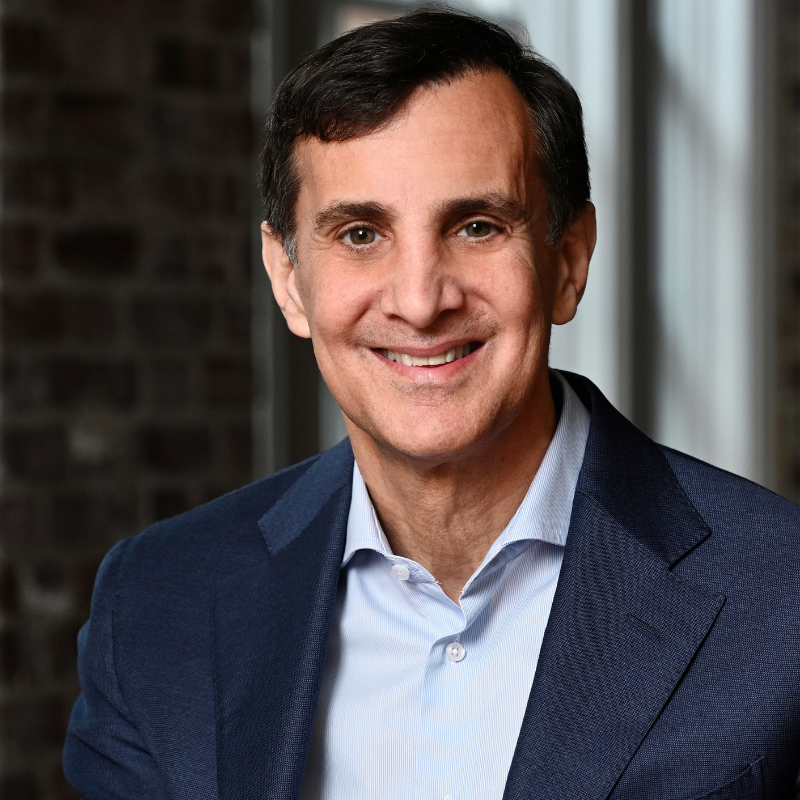 Ron Daniels is the 14th president of Johns Hopkins University, a position he has held since 2009. He previously served as provost at the University of Pennsylvania and dean and James M. Tory Professor of Law at the University of Toronto. At Hopkins, he has strengthened interdisciplinary collaboration in research and education; enhanced student access; deepened engagement with the city of Baltimore; and supported economic and social innovation. A law and economics scholar, he is the co-author of eight books and dozens of scholarly articles on the intersections of law, economics, development, and public policy. His most recent book, What Universities Owe Democracy, takes up the challenges facing democracy and argues for the indispensable role that universities play in sustaining democratic societies at this critical moment in history.
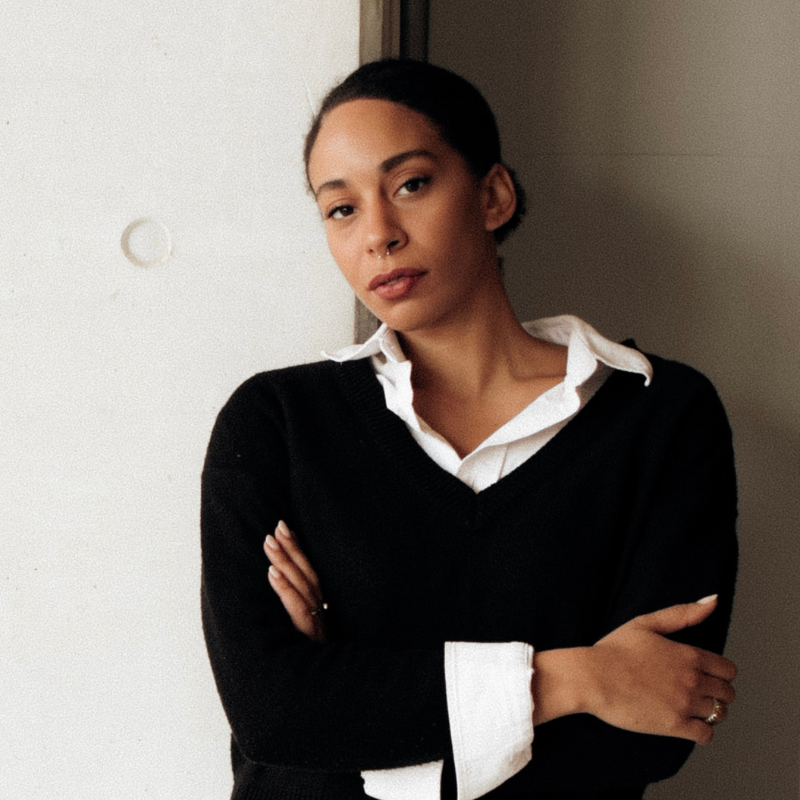 Ksenia Dania is an Athens-based filmmaker, actress, and production professional working across film, documentary, and cultural programming. Since 2019, she has been active in audiovisual production, coordinating documentaries, short films, interview-based programming, and public cultural actions through organizations including Septic Production, the Saint Maximus the Greek Institute, and the artistic collective Døcumatism, as well as media platforms such as Athens Voice and Parapolitika.gr. She is the co-founder of HumanCast, an NGO promoting inclusive artistic practices in Greece. Alongside her production and filmmaking work, she has built a multifaceted career spanning film, television, and theatre.
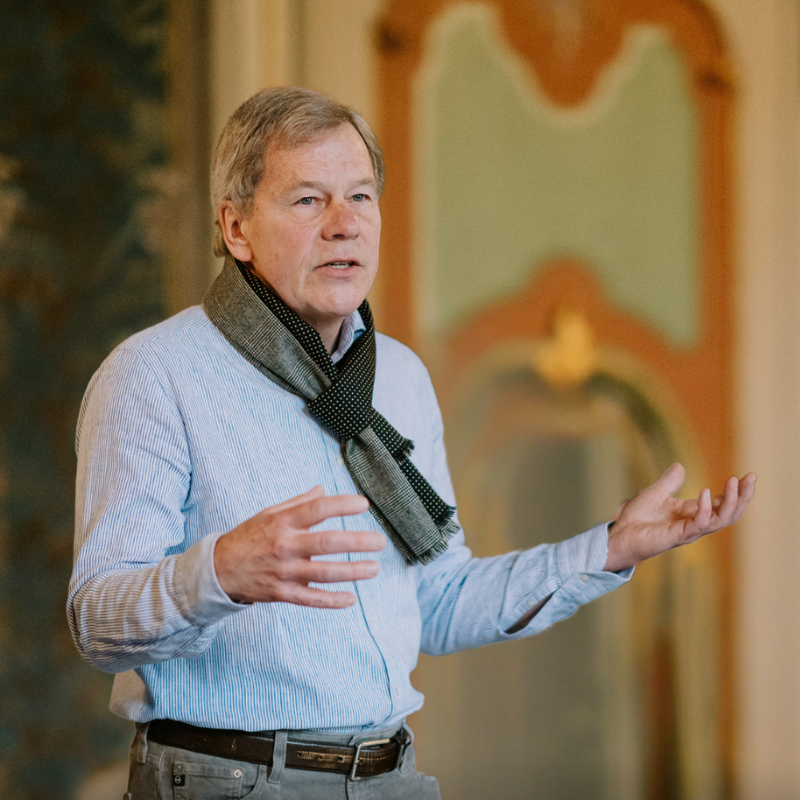 Alan Stoga (Producer and Author) is a strategist and entrepreneur with extensive experience in communications, corporate consulting, geopolitics, economics, and banking. He serves as executive chairman of the Tällberg Foundation, a Swedish foundation seeking global solutions to global challenges, and as president of Zemi Communications, a New York-based firm providing geopolitical and business intelligence to global corporations. Previously, he was senior adviser and managing director of Kissinger Associates, founded a strategic communications company and a private equity firm, and served as chief economist for the Bipartisan National Commission on Central America. He is a member of the board of the SNF Agora Institute at Johns Hopkins University, a long-term member of the Council on Foreign Relations, and holds economics and international relations degrees from Michigan State and Yale University.
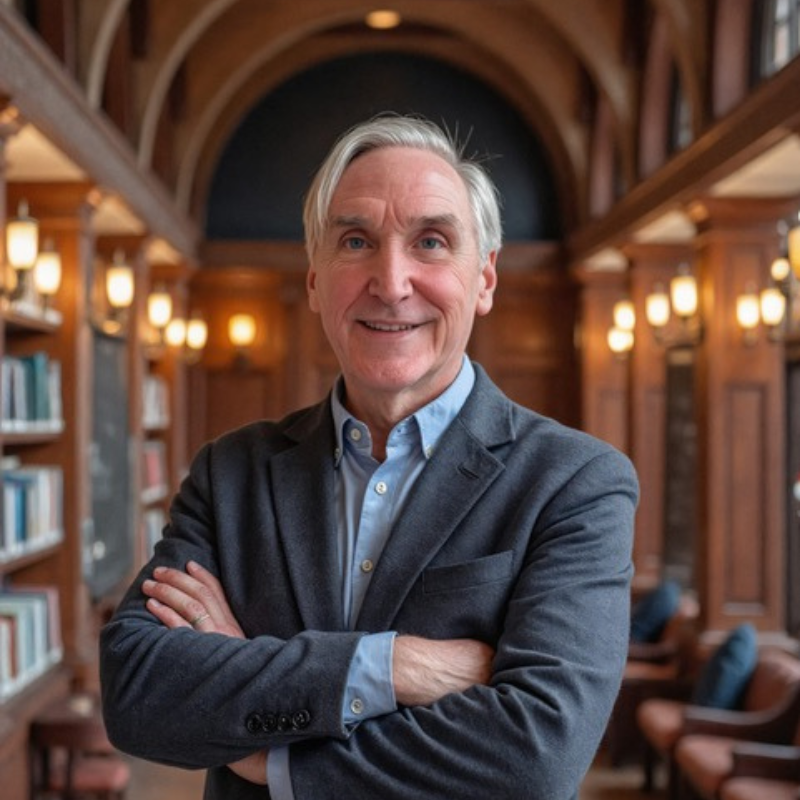 Mark Mitton (Producer) performs magic at private functions and corporate events, and creates singular entertainment and educational programs at festivals around the world. In 2024, New York Magazine named him one of its top “Reasons to Love New York.” He crafts one-of-a-kind experiences for some of the world’s most discerning audiences: cultural icons, global thinkers, and those who prefer their celebrations to remain entirely off the radar. A master of physical misdirection, Mark uses illusion to illuminate how we perceive reality and how effortlessly science, art, and everyday life can astonish. His talks on perception have taken him to Harvard, Yale, Princeton, Stanford, the Neurosciences Institute, international conferences on consciousness, and IIT Delhi. Beyond the stage, he has appeared in independent films, a music video for They Might Be Giants, and in Imponderable, Tony Oursler’s immersive 5-D film about Houdini and spirit mediums, which ran for ten months at MoMA.