
The World Health Organization says that 1 in 8 people worldwide suffer from a mental health disorder; Lancet’s 2026 Global Burden of Disease Study agrees, arguing that the affected population approaches 1.2 billion. And data from the Institute for Health Metrics and Evaluation at Washington University in the United States show a 95% increase in mental health cases between 1990 and 2023. The impact is even more profound among youth: roughly 293 million children and young adults under 25 live with a mental health condition.
Those are huge numbers—and they raise a lot of questions. What is it about modern society that is so much more stressful than the past? Does the incidence of mental health disorders differ in the Global North versus the Global South? What was the impact of COVID? Is social media a driver; how and why?
Most importantly, what can be done?
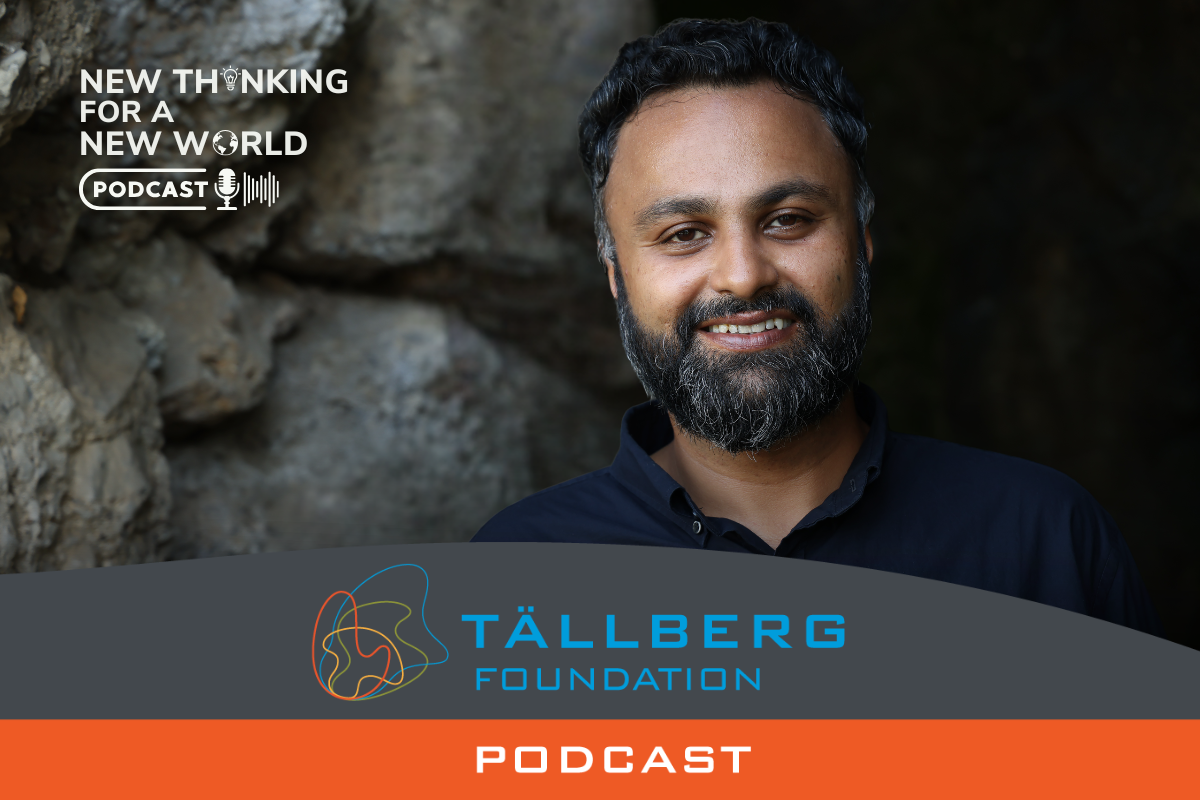
If anyone might have answers, it is Vikram Patel, professor and chair of Global Health and Social Medicine at Harvard Medical School and a co-founder of Sangath in India. Listen as he unpacks the causes of the global mental health crisis and offers some ideas on solutions. Then tell us what you think should be done.
***
You can also find New Thinking for a New World on your preferred platform, including Apple, Spotify, and YouTube.
ABOUT OUR GUEST
Vikram Patel is the Paul Farmer Professor and Chair of the Department of Global Health and Social Medicine at Harvard Medical School, and holds honorary Professorships at the Harvard Chan School of Public Health, the London School of Hygiene and Tropical Medicine, and the Public Health Foundation of India. He co-leads the Mental Health for All lab and GlobalMentalHealth@Harvard initiative, and his research focuses on the global burden of mental health problems, their links to social disadvantage, and community-based solutions. He co-founded Sangath, an Indian NGO recognized with international awards, and several global mental health networks. A Fellow of the UK Academy of Medical Sciences and member of the US National Academy of Medicine, Patel has served on India’s first National Mental Health Policy committee, co-led two Lancet Commissions on mental health, and received major honors including the Rhodes Scholarship, Sarnat Prize, Pardes Humanitarian Prize, an Honorary OBE, and the Canada Gairdner Award. He holds multiple Honorary Doctorates and was named to TIME Magazine’s list of the 100 most influential people in 2015.



I am Prof. Paul Odenigbo, the founder and research fellow in Diligent Care for Creative Intelligence Development, an organization in Consultative Status with United Nations Economic and Social Council. My work has been published by United Nations as the global changer of Reducing Inequality (UN SDG 10). My development proved that the solution to mental health inequality crises is a result of unborn child underdevelopment issues. I developed strategies to get Reassuring Optimal Newborn delivered by mothers. An averagely well developed newborn has above 120 IQ at birth. It also gets their APGAR score rating at (8-10) in a minutes of birth assured. It is evidence based science. http://www.dicideiq.org
I wonder if, in trying to understand the mental health crisis, we should also take a moment to question the world in which the human mind is expected to function.
What if, alongside asking what is happening to people, we also asked what is happening to the conditions in which people are living?
We live in a world that often asks people to adapt, perform, compete, produce, fit in, and keep moving, sometimes without giving them the time, space, understanding, or sense of belonging they need to process their experiences.
And when someone struggles to function within those expectations, we often turn our attention to what needs to be corrected within that individual.
But how much of what we call a personal problem is also a reflection of the relationship between a person and their environment?
I think we need to make room for that question without dismissing the reality of mental health conditions or the importance of professional support.
People experience the world differently. We process information differently, respond to our environments differently, and have different needs. Yet, we often measure well-being against a relatively narrow idea of what it means to be normal.
Perhaps part of the work is not only helping people cope with the world as it is, but also creating environments in which more people can feel safe enough to be themselves, understood enough to express themselves, and supported enough to discover what well-being means for them.
For me, understanding the human experience begins with a deeper question: are we creating conditions in which people can genuinely thrive, or are we becoming increasingly skilled at helping people survive conditions that may not be serving them?
Perhaps we need to investigate both.
Because understanding people should involve more than asking how we can change them. It should also involve asking what we can change about the way we live, relate, work, learn, and understand one another.