
For ordinary citizens almost everywhere, dealing with government means complicated bureaucracy, indifferent service, endless paperwork, and too often, corruption. And it is conventional wisdom almost everywhere that democracy is in decline, with citizens’ voices barely heard. Could technology change all that?
On the one hand, information technology—especially Artificial Intelligence—seems tailor-made to deliver efficiency and practical solutions to people confronted with seemingly impenetrable officialdom. Smart tech > dumb bureaucracy. On the other hand, cyber security and privacy are obvious risks, as demonstrated by seemingly daily tech outages. And at the core is the question of reliable control over AI agents: is it possible?
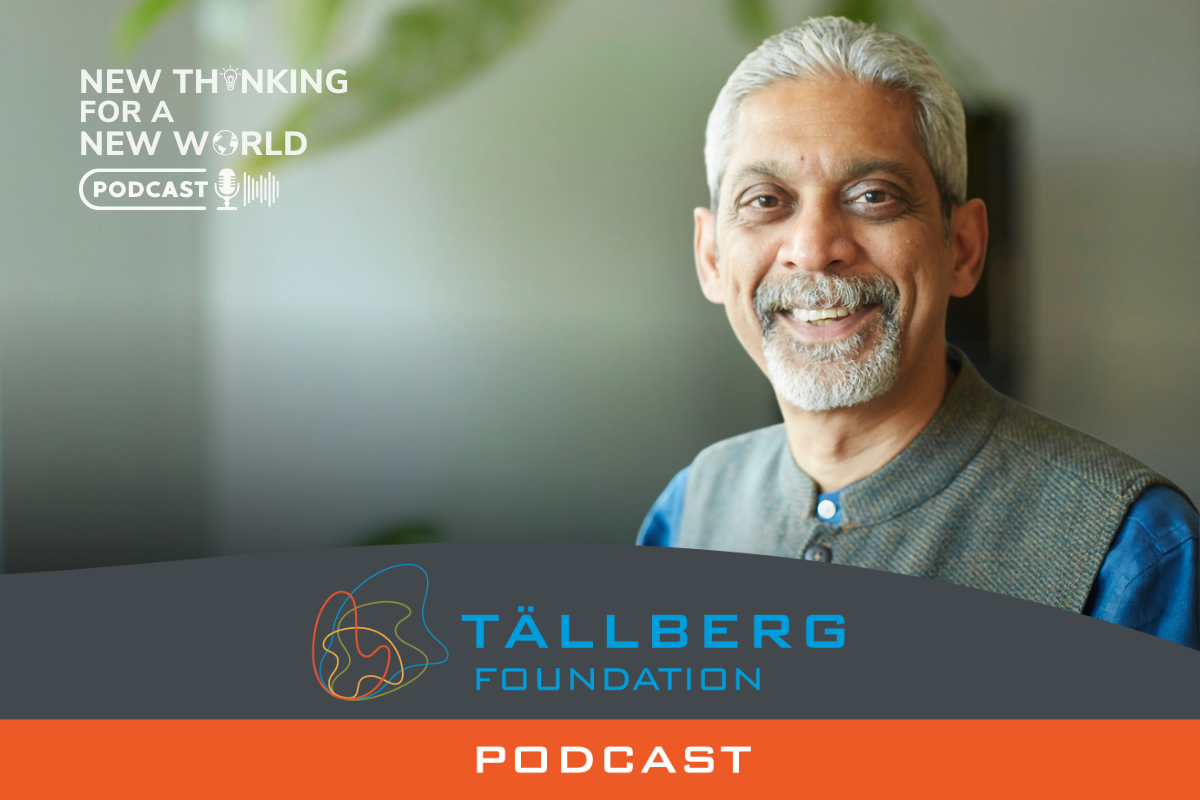
Our guest this week on the New Thinking for New World podcast is Victor Liakh, President of the Ukraine-based East Europe Foundation. Over the last two decades, his work has focused on building effective digital government that both facilitates citizens’ interactions with government and lets them participate in decision-making. Of course, during that time, Ukraine has suffered two invasions, which makes his work more difficult and his efforts even more extraordinary.
Listen as Victor shares what works, what he worries about, and what lessons he thinks Ukraine can share with the rest of us.
What do you think? Let us know in the comments below.
You can also find New Thinking for a New World on your preferred platform, including Apple, Spotify, and YouTube.
ABOUT OUR GUEST
Victor Liakh is President of East Europe Foundation (EEF), an international charitable organisation and one of Ukraine’s largest non-profits, which delivers programmes in support of Ukraine, including international technical assistance projects.
Victor began his career in the social sector, working at the Ukrainian State Centre for Social Services for Youth and the UNICEF Office in Ukraine; from 2005 to 2008 he headed Child Well-Being Fund Ukraine. He joined EEF as Executive Director in 2008 and has been its President since 2012. Over that time the Foundation has grown from a small team into an organisation of more than 140 professionals and has channelled over $66 million into more than 150 programmes supporting democracy, civil society, effective governance, small business and energy efficiency.
Under his leadership, EEF has become one of the key partners of the Ukrainian state and international donors in Ukraine’s digital transformation. Through the EGAP (E-Governance for Accountability and Participation) Programme, supported by Switzerland since 2015, the Foundation has contributed to the development of the Diia portal and app, more than 80 e-services, the E-DEM e-democracy platform and the Diia.Education platform. Since the start of the full-scale war, EEF has combined this work with humanitarian support, equipping bomb shelters in schools and mine-safety education.
In 2008, Victor took part in the John Smith Trust Fellowship Programme, studying corporate social responsibility at Business in the Community. He later completed the US Department of State’s International Visitor Leadership Program (IVLP) in 2011 and the Draper Hills Summer Fellows Program at Stanford University’s Center on Democracy, Development and the Rule of Law (CDDRL) in 2017.
Victor writes widely, with articles published by the Atlantic Council and The National Interest, among others, and is preparing a book on the nature of modern armed conflict. An engineer by training (Kyiv Polytechnic Institute), he also holds a master’s degree in social work and, as a doctoral researcher, studies the role of civil society organisations in supporting internally displaced people.


0 Comments