
“The whale has no voice,” Herman Melville wrote in Moby Dick. “But then again,” he went on, “What has the whale to say?”
Turns out he was wrong: not only do sperm whales have voices, but these massive, amazing mammals talk constantly to each other. They are humongous creatures: males can be 18 meters long and weigh 45 tons. Think something the weight of an industrial dump truck, but twice as long. Despite their massive size and the capacity to dive more than a mile into the depths of the ocean, they apparently are quite sociable.
How amazing would it be if we could decipher what they are saying? That’s the passion of David Gruber, a marine biologist and technologist who organized and leads Project CETI (Cetacean Translation Initiative). He has gathered a team of 50 global scientists and technicians dedicated to understanding what the sperm whales are saying to each other—not so we can talk to them, but so that we can understand how they think about the world we share.
David is also one of the recipients of the 2025 Tällberg-SNF-Eliasson Global Leadership Prize, who was honored for his work with CETI and his underlying drive to help humans and nature co-exist.
Listen as he discusses what drives him and CETI.
***
You can also find the New Thinking for a New World on your preferred platform, including Apple, Spotify, and YouTube.
ABOUT OUR GUEST
Da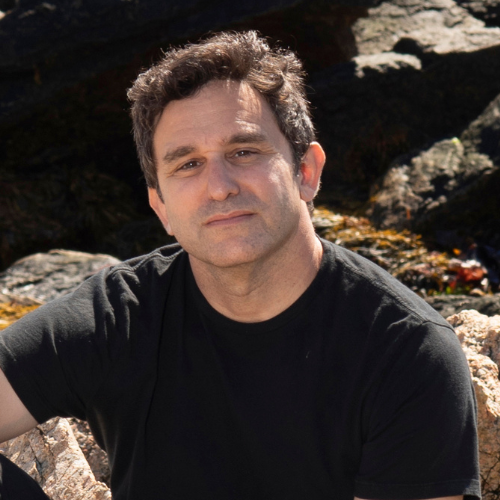 vid Gruber is the Founder & Lead of Project CETI (Cetacean Translation Initiative), a nonprofit organization as well as a National Geographic Society program that brings together over 50 scientists across eight disciplines to translate the communication of sperm whales. CETI has made pioneering scientific discoveries such as the elucidation of the sperm whale phonetic alphabet.
CETI’s vision is that these findings applied across species to exemplify how technology deepens human connection and motivation to protect the natural world. Gruber fostered the CETI – NYU School of Law’s “More Than Human Life” (MOTH) program collaboration. Together CETI and MOTH have published a futuristic legal article (What if We Understood What Animals Are Saying? The Legal Impact of AI-Assisted Studies of Animal Communication) that maps the potential impact for CETI’s findings on protections for whales and other lifeforms. CETI also conducts youth education and arts initiatives in Dominica, where its core research takes place, as well as global storytelling and arts initiatives.
Gruber is also Distinguished Professor of Biology and Environmental Sciences at the City University of New York and has been a National Geographic Explorer since 2014. His two decades of research before CETI, focused on climate, coral reef and deep ocean science. His laboratory invented technologies to perceive the underwater world from the perspective of marine animals, such as the “shark-eye-camera.” His research team discovered over 200 new species of biofluorescent fish and made the first observations of biofluorescence in sea turtles. And, through his long-standing collaboration with the Harvard Microrobotics Laboratory, Gruber has helped engineer some of the most gentle robotic systems ever created to study and interact with marine life.
Gruber also integrates science and art to expand public understanding of the natural world. He has collaborated with pioneering video and performance artist Joan Jonas for over a decade and co-curated the 2022 exhibition “Who Speaks for the Oceans?” at the Mishkin Gallery and the Tarble Arts Center. He holds a PhD in biological oceanography from the Rutgers Institute of Marine and Coastal Sciences and master’s degrees in coastal environmental management from Duke University and in journalism from Columbia University. From 2017-2018, David was a Fellow at the Radcliffe Institute for Advanced Study at Harvard University.


very educational and one of its kind