
It is not news that democracy is in trouble almost everywhere. Poll after poll shows that people in most countries—especially in the West and throughout the Americas—are disappointed with democracy as it exists today. This is particularly true among young people, many of whom seem to prefer a strong leader to the apparent impotence of their democratic leaders.
Of course, there are exceptions, and we should celebrate them. Top of that list is Bangladesh, with a history of autocratic leaders, some of whom used elections to hang on to power for years. However, during the summer of 2024, a student-led revolution succeeded in expelling the government of Sheikh Hasina, who had ruled for 15 years.
Fast-forward to February 2026, and Bangladesh has just conducted an election that, by all accounts, was mostly free, fair, and peaceful. The result was that the interim government, led by Nobel Prize-winning Muhammad Yunus, has now been replaced by a democratically elected government. From start to finish, the entire transformation took less than 20 months.
Score one for democracy!
Our guests on New Thinking for a New World were in the front ranks of that revolution. Aysha Siddiqua Tithi and Umama Fatema were both leaders of Students Against Discrimination, the organization that drove the revolution. Listen as they discuss their experiences and hopes for their country’s future.
***
You can also find the New Thinking for a New World on your preferred platform, including Apple, Spotify, and YouTube.
ABOUT OUR GUESTS
 Aysha Siddiqua Tithi is a Computer Science student at Brac University and an internationally recognized Bangladeshi youth activist. She emerged as a leader of the 2024 anti-discrimination student movement and represented youth voices at the 79th UN General Assembly alongside Nobel Laureate Muhammad Yunus.
She co-founded She Leads to empower women and works with the Zero Missing Children Foundation to protect children’s rights. Aysha has held leadership roles at Brac University and contributes to civic training initiatives. Blending technology and activism, she focuses on innovation, human rights, and climate justice, aiming to advance equity and sustainability through tech-driven solutions.
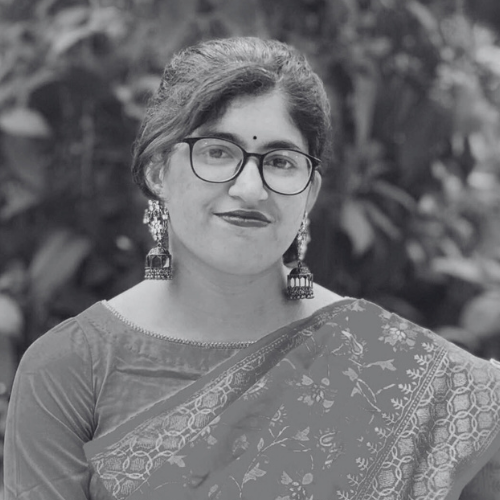 Umama Fatema is a Bangladeshi student activist and youth leader committed to social justice and education reform. A graduate of the University of Dhaka, she rose to national prominence during the 2024 July Uprising, advocating for quota reform and greater transparency in public institutions. As a coordinator and spokesperson for Students Against Discrimination, she mobilized thousands of students and championed the rights of marginalized groups. Known for her clear, inclusive leadership, she previously served as General Secretary of the Dhaka University branch of the Bangladesh Chhatra Federation and remains active in youth empowerment and women’s rights advocacy.


I was surprised to see two Bangladeshi girls presented in this podcast as “July leaders” speaking about democracy. What is being promoted as democracy here is deeply disputed by many people in Bangladesh.
The regime change that happened in July and was described as a “student movement” was not simply a student-led revolution. Many people now believe it involved organized violence and external influence. There are growing concerns that certain foreign interests used the narrative of student protests to serve their own agenda.
At that time, many ordinary citizens were frustrated with the government, so the situation was easy to manipulate. Bangladesh has also long had political groups that opposed the independence spirit of the country and historically aligned with Pakistan-backed narratives.
Promoting these figures as symbols of democracy without acknowledging these complexities is concerning. I hope respected platforms like the Tallberg Forum will look more carefully at the reality in Bangladesh and avoid amplifying misleading narratives.
The condition of the country in the last 19 months speaks for itself.
Thank you for sharing your perspective, Protima. Political transitions are complex, and we welcome thoughtful dialogue. That said, the July 2024 uprising in Bangladesh was among the most extensively documented mass movements in recent South Asian history, covered by major international media, with a UN fact-finding report identifying approximately 1,400 people killed and thousands injured. We stand behind the integrity of our mentee selection process and respect that views on individuals may differ. However, we would gently push back on characterizations that dismiss the movement as externally engineered — this risks minimizing the courage and sacrifice of those who participated. We remain committed to amplifying genuine civic leadership and are grateful for this dialogue.